




KITE Trainee Innovations Showcase
Please join us for the return of our series: KITE Trainee Innovations Showcase -happening right here at the KITE Innovations Gallery!
This is an opportunity for trainees to share their extraordinary work to all of us here at KITE-UHN and the members of the public. The Trainee Innovations Showcase was established to showcase some of KITE’s research in simple terms so that members outside of academia can understand the amazing research that our trainees do. Furthermore, it is a great way to connect with everyone, support your colleagues, and recruit participants for research studies. The selected trainees will be assigned to stations at the Innovations Gallery where everyone can walk around and have a chance to learn about their research, as well as engage in a fun interactive component!
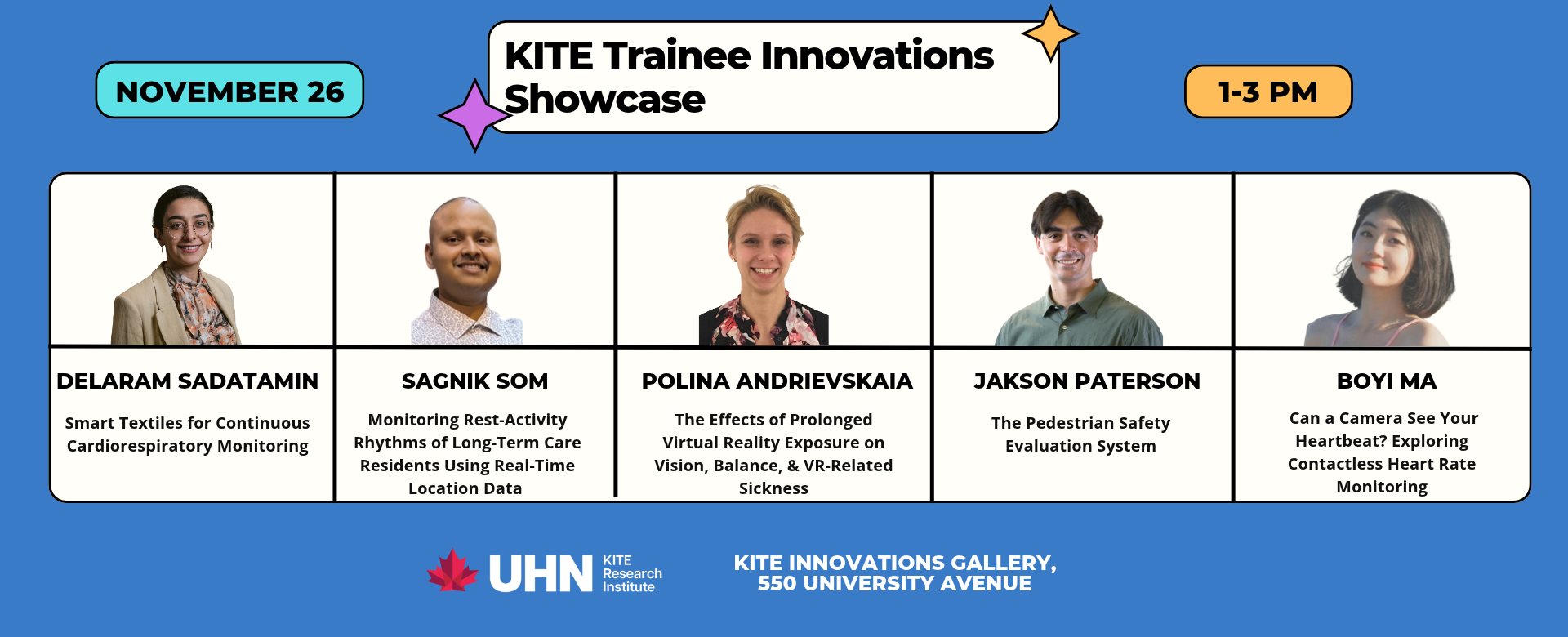
Research projects by the following five KITE trainees will be presented.
What if everyday clothing could help monitor your heart and breathing?
Our research explores the development of textile-based wearable technologies for comfortable, continuous, and non-invasive health monitoring, particularly for older adults.By integrating textile electrodes into wearable garments, our prototype aims to monitor multiple physiological signals. Unlike conventional monitoring systems that often rely on adhesive electrodes and bulky equipment, our approach aims to make physiological monitoring more comfortable, accessible, and suitable for long-term use at home.
Long-term care residents with dementia often experience disrupted rest and activity patterns, which is linked to agitation, falls, further cognitive decline, and increased care burden. Traditionally, changes in these patterns were only captured through periodic staff observation or subjective reports. This project uses real-time location systems (RTLS) to track these patterns. RTLS is a more objective method that many care homes already have installed for safety and nurse-call. By clustering data from 1161 residents from 12 care homes, this work identifies common rest-activity profiles and tracks how residents' patterns change over time, flagging meaningful shifts that might otherwise go unnoticed. It showcases what these movement patterns look like and how a clinician can spot them.
Polina Andrievskaia showcasing The Effects of Prolonged Virtual Reality (VR) Exposure on Vision, Balance, & VR-Related Sickness
Virtual Reality (VR) is a transformative technology with ample applications extending far beyond the entertainment industry, including in healthcare, education, and business. However, individuals may experience symptoms such as nausea, dizziness, eyestrain, blurred vision, and disorientation during extended VR use. This project therefore investigates how prolonged VR exposure through commercially available VR gaming can lead to the development of VR sickness and affect vision and balance. Visit us to learn more about the study, explore the VR game used in this work, and gain insight as to how we are measuring these effects before and after VR use.
Jakson Paterson showcasing The Pedestrian Safety Evaluation System
Current pedestrian infrastructure creates barriers and inequitable access for people with disabilities, especially in the winter. Computer vision offers an opportunity to observe and quantify the external risk factors impacting pedestrians. The Pedestrian Safety Evaluation System uses computer vision algorithms to track thousands of pedestrians crossing Toronto intersections to understand their behaviours surrounding environmental risk factors (like snow and low lighting) as well as their interactions with other road users. Step into the shoes of the pedestrians in the video display, examine the environmental safety concerns and pedestrian-vehicle interactions that are typically overlooked when we discuss pedestrian safety in urban environments.
Measuring heart rate usually involves wearing a sensor or attaching electrodes to the body. But could an ordinary camera offer a contactless alternative? My research explores how facial videos can be used to estimate heart rate by detecting tiny changes in skin colour caused by blood flow. The goal is to understand how reliably this approach works and move towards more comfortable, accessible heart rate monitoring.