




Pride in Patient Engagement in Research - PiPER

Contact Us:
Contact:
Email: piper@uhn.ca
Phone: 416-597-3422 x 7668
Follow us on Social Media:
LinkedIn: @piperuhn
Bluesky: @piper-uhn.bsky.social
Our address:
University Health Network
550 University Ave, 11-151
Toronto, Ontario M5G 2A2
Become a PiPER Member!
By becoming a PiPER Member, you will receive up-to-date information about opportunities to engage in research at UHN (PLEX Network), events (Communities of Practice, roadshows, webinars, events) and resources (toolkits, educational materials) related to PiPER.

What is PiPER?
Pride in
Patient
Engagement in
Research
(PiPER)
is a strategic UHN-wide research initiative at University Health Network (UHN) that launched in February 2022. The PiPER initiative was one of the priorities of the UHN Research Strategic Plan 2019-23, under the pillar "Engage Every Patient to Strengthen our Learning Health System".
The renewed UHN Research Strategic Action Plan continues to highlight the PiPER initiative. PiPER supports the strategic direction of "Transformative Experiences," which aims to foster an inclusive and collaborative research environment. By engaging people with lived experience (PLEX) as partners in research, PiPER enhances health research outcomes and ensures that the knowledge gained is shared with patients, families, caregivers, and communities.
Vision
Our vision is a future where UHN is an international exemplar for the participation of patients, families, and partner organizations in our research. This engagement is authentic, accountable, transparent, and responsive and predicated upon our mission.
Mission
To make engaging patients, families, and care partners in research a new culture that can enhance health research, outcomes, and care experiences for all.
Our Goals & Aims
Our goal is to build organizational structures and technology that promote and embed the engagement of people with lived experience in our research. Our aim is for that engagement to be authentic, accountable, transparent, and responsive.
We aim to:- Develop an organizational structure that ensures authentic, accountable, transparent, and responsive patient engagement in research at UHN
- Build an organizational culture that promotes and disseminates an “opt-in” philosophy across a broad range of patient engagement in research activities at UHN
- Create coordinated internal and external communication articulating the value of patient engagement in research for UHN staff, patients, families, care partners, and partner organizations
- Integrate patient engagement in research culture and processes within other clinical, research, and educational programs and services at UHN
Our Values
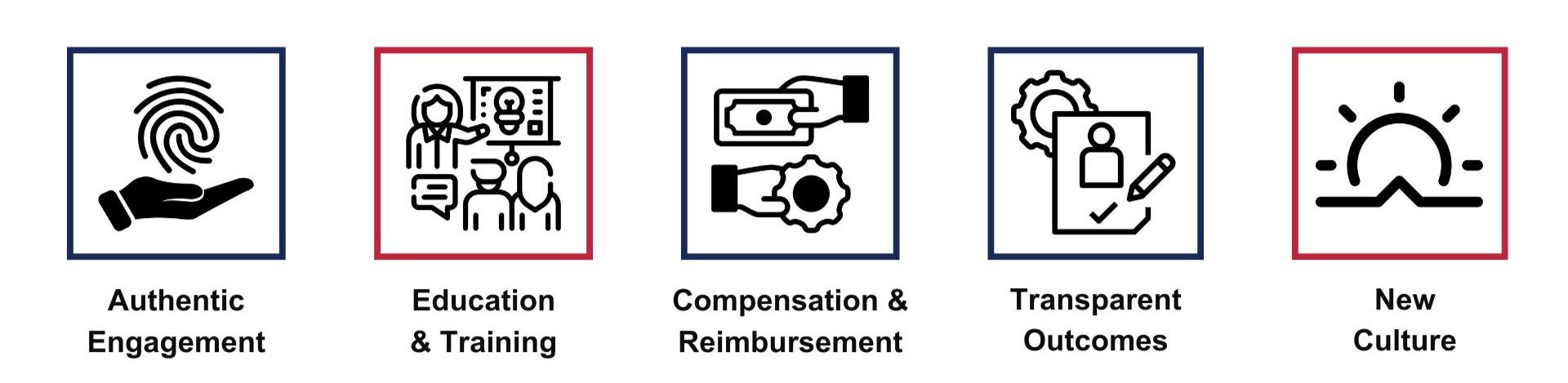
Our Guiding Principles
- Prioritize Inclusion, Diversity, Equity, and Accessibility (IDEA)
- Address power dynamics
- Build trust
- Foster reciprocal relationships
- Ensure sustainability
- Explore value proposition
Our Structure
We have established the structure below to oversee and support the PiPER vision:
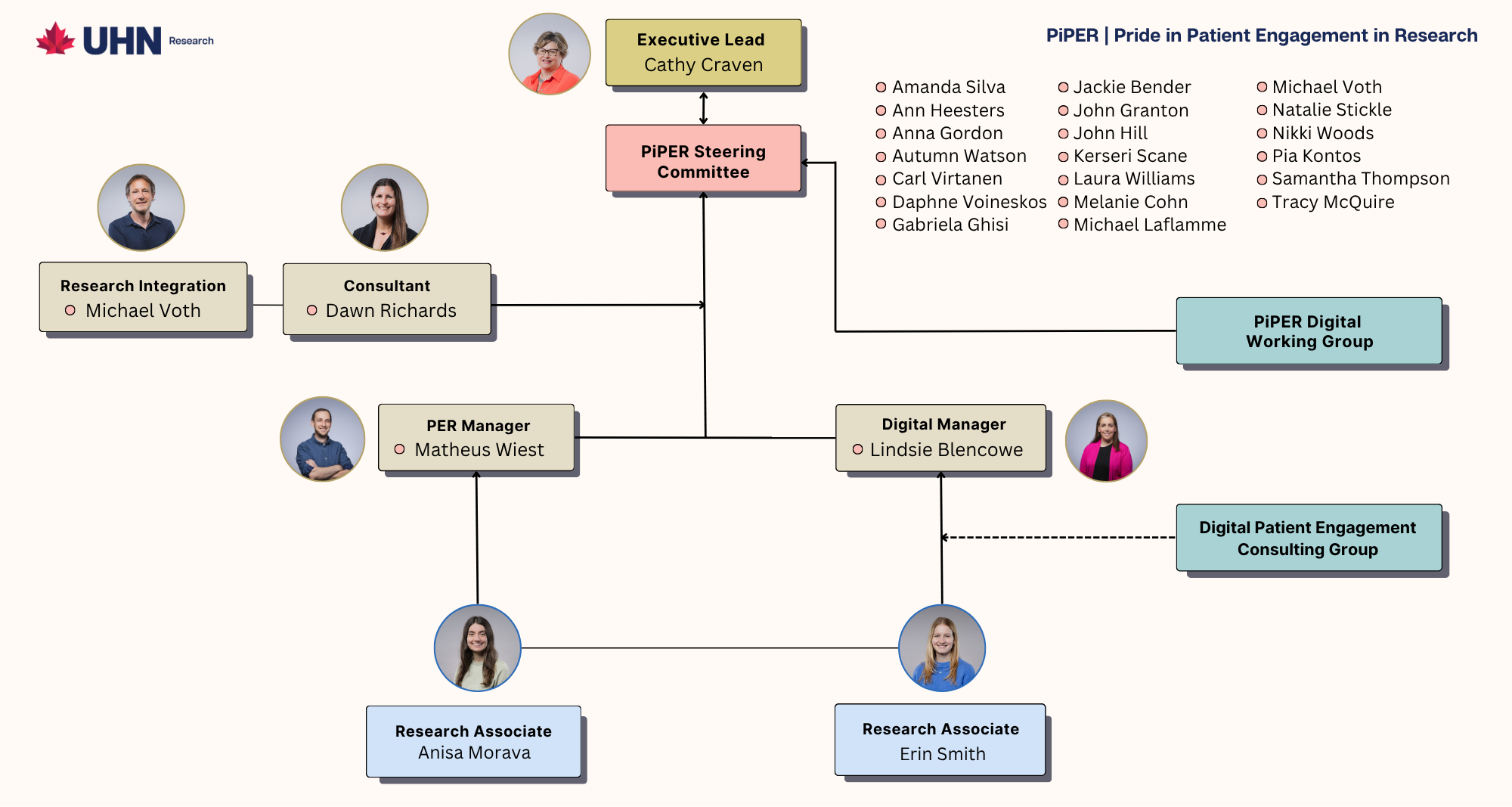
Who are we?
Our team members help support the day to day activities of PiPER:

Cathy Craven, BA, MD, MSc, FRCPC, FASIA (she/her)
PiPER Lead,
I am the Toronto Rehabilitation Institute/ University of Toronto Chair in Spinal Cord Injury (SCI) Rehabilitation, Professor in the Department of Medicine at the University of Toronto, Medical Director of the Spinal Cord Rehabilitation Program and Senior Scientist at KITE Research Institute within University Health Network (UHN). I also lead the PiPER initiative, Chair the PiPER Steering Committee, and sit on the Board of Directors for the Ontario Strategy for Patient-Oriented Research SUPPORT Unit (OSSU).

Michael Voth, MSc, CQA (he/him)
PiPER Team Member
I am the Senior Manager of Clinical Research Quality and Compliance where I provide leadership in the planning, conduct and reporting of quality and risk management activities within UHN Research. In my role on the PiPER team, I provide strategic support, facilitate collaborations, and advise on UHN policy and standards, developing and delivering training, and performing internal quality audit and compliance activities to ensure we meet the expectations of our external funders, regulators and community for high quality research at UHN.

Dawn Richards, PhD (she/her)
PiPER Consultant

I am an analytical chemist by training, however living with rheumatoid arthritis and osteoarthritis has profoundly impacted my career. In my role with the PiPER team, I am helping set up some of the foundations related to patient engagement in research at UHN. Specifically, I am contributing to the development of role descriptions for patient partners, establishing a patient engagement community of practice, and facilitating work related to other patient engagement events.

Anisa Morava, BSc, MA, PhD (she/her)
PiPER Team Member
Anisa Morava is a Research Associate I - Patient Engagement at UHN. Anisa arrived in Hamilton, Ontario, Canada in 2001 from Japan where she was born to Albanian parents and spent her formative years. Anisa learned English at the age of five. She has had the pleasure of living in a few different cities in Ontario, including Guelph and London and is now living in Toronto.
Anisa completed her undergraduate studies in Psychology, Neuroscience and Behaviour at McMaster University and her Master’s and PhD in Kinesiology at Western University. During her time at McMaster, she explored the use of Goal Management Training as an executive function intervention in Acquired Brain Injury. During her graduate studies, she examined the use of acute exercise-based intervention to promote cognitive functioning and stress reduction in young adults. She has experience with systematic reviews and exercise-based intervention studies. She is passionate about patient engagement and looks forward to building our community of practice at UHN.

Erin Smith, BSc, MPH (she/her)
PiPER Team Member
Erin Smith is a Research Associate on the Pride in Patient Engagement (PiPER) team at the University Health Network. Erin is a fourth-generation Canadian with ancestors of British and Greek-Macedonian heritage. She is proud to have called Toronto, or Tkaronto, home for most of her life. Erin enjoys spending time year-round in Ontario’s wilderness and provincial parks, specifically Algonquin Park and Haliburton.
Erin attended the University of Guelph for her undergraduate studies where she completed a Bachelor’s of Science in Biomedical Science. She obtained her Master’s of Public Health from McMaster University, where she conducted a project that engaged community members to improve communication and public messaging during the COVID-19 pandemic. Erin’s previous work experience has included a focus on health promotion and the social determinants of health, as she worked at a local public health unit to help support equity-deserving populations in Northern Ontario. She is passionate about patient engagement and developing equitable research processes and health outcomes for all patient populations served by UHN.

Matheus J. Wiest, PhD (he/him)
PiPER Team Member
Matheus Wiest (or just Mat Vee-st) emigrated from the traditional territories of the Tupi-Guaranis (Brazil) to Treaty 6/Metis Nation of Alberta Region 4 (Edmonton) in 2011 to complete his PhD training, where he studied how to improve rehabilitation for people living with physical disabilities.
He has been part of UHN since 2017, working in rehabilitation research and on provincial and national initiatives improving the quality of care for people living with brain and spinal cord injuries. At PiPER, Mat is the Patient Engagement in Research Manager, overseeing the team activities and working as a facilitator to meaningfully engage patients and their carers in the research produced at UHN. He is a football fan and an occasional fisherman.

Lindsie Blencowe BSc (Hons), MSc, CCRA, PhD (she/her)
PiPER Team Member
Lindsie Blencowe is the PiPER Digital Manager, supporting Pride in Patient Engagement in Research (PiPER Digital) at UHN. Lindsie is a second-generation Canadian with strong familial ties to both Canada and Scotland. In her spare time, Lindsie enjoys coordinating her local knitting guild and spending time camping with her family.
Lindsie is a biochemist and clinical researcher by training and has more than 22 years of experience working in health research. She received her Honours Bachelor of Science from Queen's University and her Master of Science degree and Clinical Research training at McMaster University. She obtained her PhD from the University of Toronto, Institute of Medical Science.
Lindsie has also been a UHN patient for more than 20 years. Her personal and professional experiences at UHN make Lindsie passionate about engaging patients as partners in our research programs. Lindsie has previously been involved in many knowledge translation and patient education projects at UHN. Most recently, she worked with patient partners on a patient-focused podcast series. Lindsie has diverse interests and skills which include graphic design, web-app and website development.
Definitions
Concepts and terms have different meanings to different people. The definitions below can be used in your work on engaging people with lived experience as partners in research at or with UHN. This can help make sure that everyone has a common understanding of the words that are being used.
Persons with lived experience (PLEX)
PLEX is a person with experience of a health condition. They may live with a condition (patients) or have had experiences interacting in the health system (caregivers, family members). PLEX:
- Provide perspectives and insights based on their 'lived experiences'
- Partner with research teams in planning, doing and sharing research rather than being study participants
Other terms you may also hear to describe a PLEX include person with lived experience shortened as "PWLE", “person with lived expertise”, “knowledge users”, or “patient research partner”.
Patient Engagement
Patient engagement is meaningful and active collaboration with patients as partners in the research. Sometimes you may hear the term patient and public involvement (shortened as "PPI") used instead.
Patient Engagement in Research
PLEX engagement in research (PER) refers to engaging PLEX partners in different ways throughout the research process so they can provide their own lived experiences, insights, and perspectives. The intent of the engagement is to improve the research and the relevance of the research results. PLEX engagement in research does not mean that the overall approach to research needs to change, instead it means bringing PLEX partners to the team so they can contribute in ways that complement the expertise and knowledge of the other research team members. PLEX engagement in research is also called “patient-oriented research”, “patient and public involvement (PPI)”, “patient and stakeholder engagement”, and “consumer engagement in research”.
Learning Health System
A healthcare system in which knowledge generation processes are embedded into daily practice to improve research, care, and communication. A learning health system continuously collects and analyzes data to generate knowledge, engage partners, and enable informed and timely decisions.
New Version of The PiPER Toolkit
The PiPER Toolkit is a summary of concepts, resources and tools to help plan, do, evaluate and share research in partnership with PLEX.
Help us to understand how the Toolkit is being used and ways to improve it. Please complete this anonymous, 2 min survey: Complete the PiPER Toolkit Feedback Form(opens in a new tab) .

Check out the PiPER SharePoint(opens in a new tab) for more information on the PiPER Toolkit (internal connection required)
How to cite the Toolkit:
Pride in Patient Engagement in Research (PiPER) Team. (2026, August, v2.0). Engaging People with Lived Experience in Research at University Health Network. Pride in Patient Engagement in Research – PiPER.
What is our Community of Practice?
A Community of Practice is a group of people with shared interests and goals who come together to learn, exchange knowledge, and share resources related to a specific topic.
People with lived experience (PLEX) and researchers co-present how they partnered to do research, lessons learned and opportunities to improve research processes and outcomes. These free live webinars are delivered over Zoom and enable attendees to learn about the engagement of PLEX as partners in different types of research and connect with others with similar interests!
How to get involved?
You can learn about upcoming Communities of Practice by becoming a PiPER Member (add your name and email to the box to the left) and by following us on LinkedIn and BlueSky.
Community of Practice Guiding Principles

Sessions
Find out about the next Community of Practice by becoming a PiPER member (fill box to the left), following us on social media (LinkedIn and BlueSky), or checking out the PiPER SharePoint (internal connection required).
Catch up on our previous sessions by clicking on the image to watch the presentation recording or a summary of the key discussion points and resources:
PiPER Research Day 2025
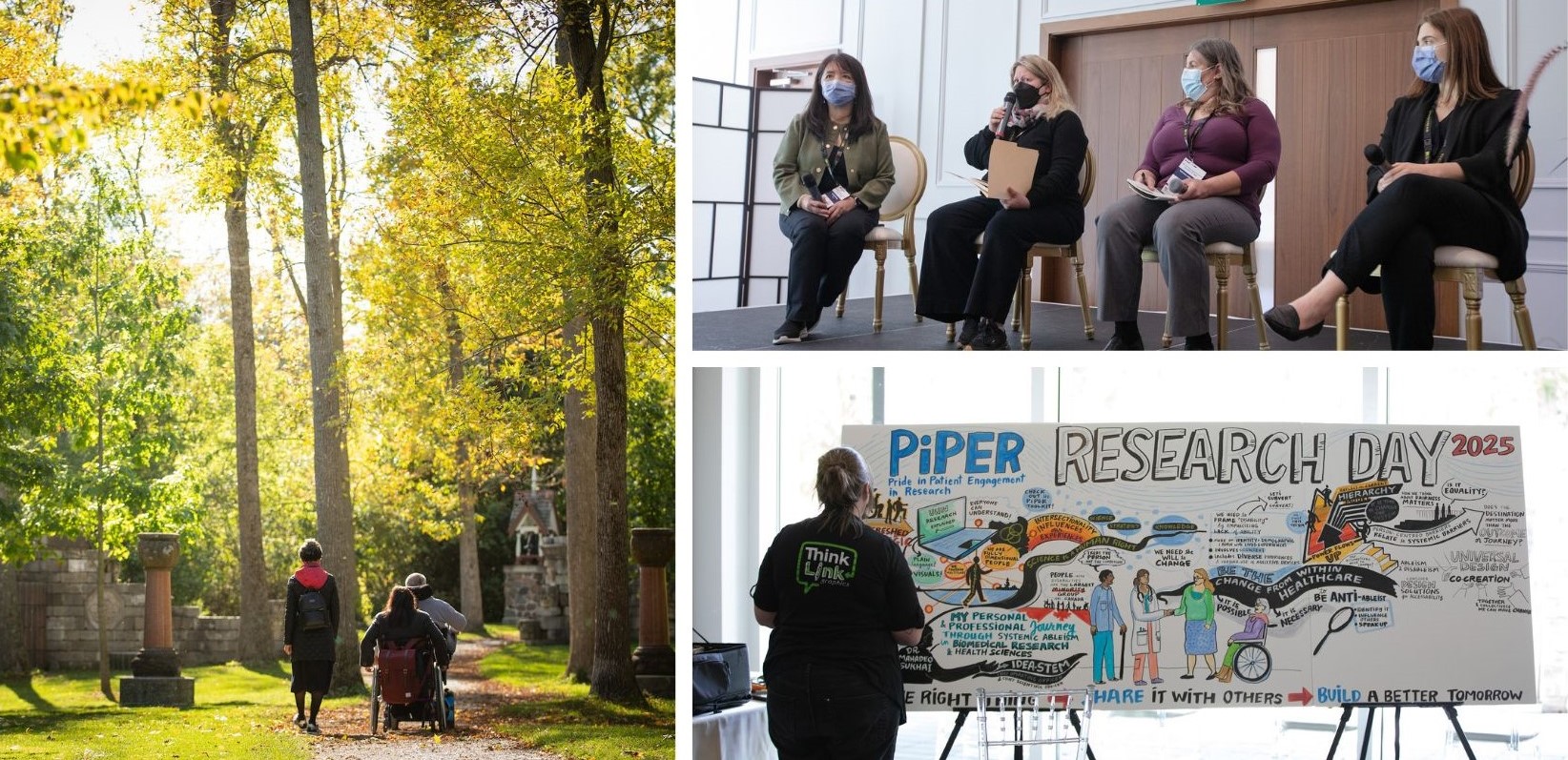
The 3rd Annual PiPER Research Day was held on October 8, 2025. The event featured dynamic presentations, workshops, and panels centred on the theme of "Do the Right Thing, Share It With Others, Build a Better Tomorrow".
Participants were encouraged to reduce duplication, abandon ineffective practices, learn from one another, and work collectively toward building a better future.
Click HERE for a Summary Report of PiPER Research Day.
PiPER Research Day 2024

The 2nd PiPER Research Day took place on October 9, 2024! PiPER Research Day delivered a compelling and urgent message: creating a more inclusive and effective learning health system is not only necessary but possible, particularly through engaging people with lived experience in research. PiPER Research Day reinforced that institutions like UHN must lead the way by embedding the voices and perspectives of patients at the heart of our research.
All recordings available of Research Day 2023 can be selected by clicking in the top-right corner of the screen below:
PiPER Research Day 2023
The inaugural PiPER Research Day was held on October 5, 2023! The hybrid event featured keynotes, panels, virtual poster sessions, interactive workshops, storysharing sessions, and an art exhibit on the following themes:
- Advancing Inclusion, Diversity, Equity, Accessibility, & Allyship
- Deepening Practices, Approaches, and Considerations
- Building Capacity for Partnership
- Measuring Engagement & Impact
Missed the event? Check out the different sessions that were recorded at PiPER Research Day in the playlist below. All recordings available of Research Day 2023 can be selected by clicking in the top-right corner of the screen below:
Interested in learning more about Plain Language Summaries, PLEX engagement in Research (PER), and our PiPER PER Toolkit? Then book a roadshow with the PiPER Team! You can book a roadshow for your team, department, institute, or organizational department. Contact piper@uhn.ca for more information.
Please note: At this time, these roadshows are only available for UHN-affiliated entities and research teams.
- September 25 2024: UHN Office of Research Trainees - PiPER Toolkit Roadshow "Register here"
Educational Videos
The PiPER team creates short videos to help educate and share information about topics related to patient engagement in research.
Click the icon to watch the short youtube video!
| Topic | Video |
|---|---|
| What is patient engagement in research |
Plain Language Summaries
| Topic | Video |
|---|---|
| How to write a plain language summary |
Grant Opportunities
Click on the button below to learn more information about our previous calls for proposals
See a list of previous awardees HERE. (internal connection required)
NewsLetters
The PiPER team sends out quarterly newsletters sharing updates from our work, opportunities to be engaged, and resources related to patient engagement in research.
Check out our previous issues below!
| January 2026 | June 2026 | September 2026 | December 2026 |
|---|---|---|---|
| Coming Soon! |
| May 2025 | June 2025 | September 2025 | November 2025 |
|---|---|---|---|
| Summer 2022 | Spring 2023 | Summer 2023 | Fall 2023 |
|---|---|---|---|
Have a story, opportunity, or resource to share? Email us at piper@uhn.ca
Person with Lived Experience (PLEX) Network
The Person with Lived Experience (PLEX) Network is a PiPER initiative that aims to promote connection and collaboration between people with lived experience, researchers at UHN, and community organizations.
PLEX includes patients, families, and caregivers.
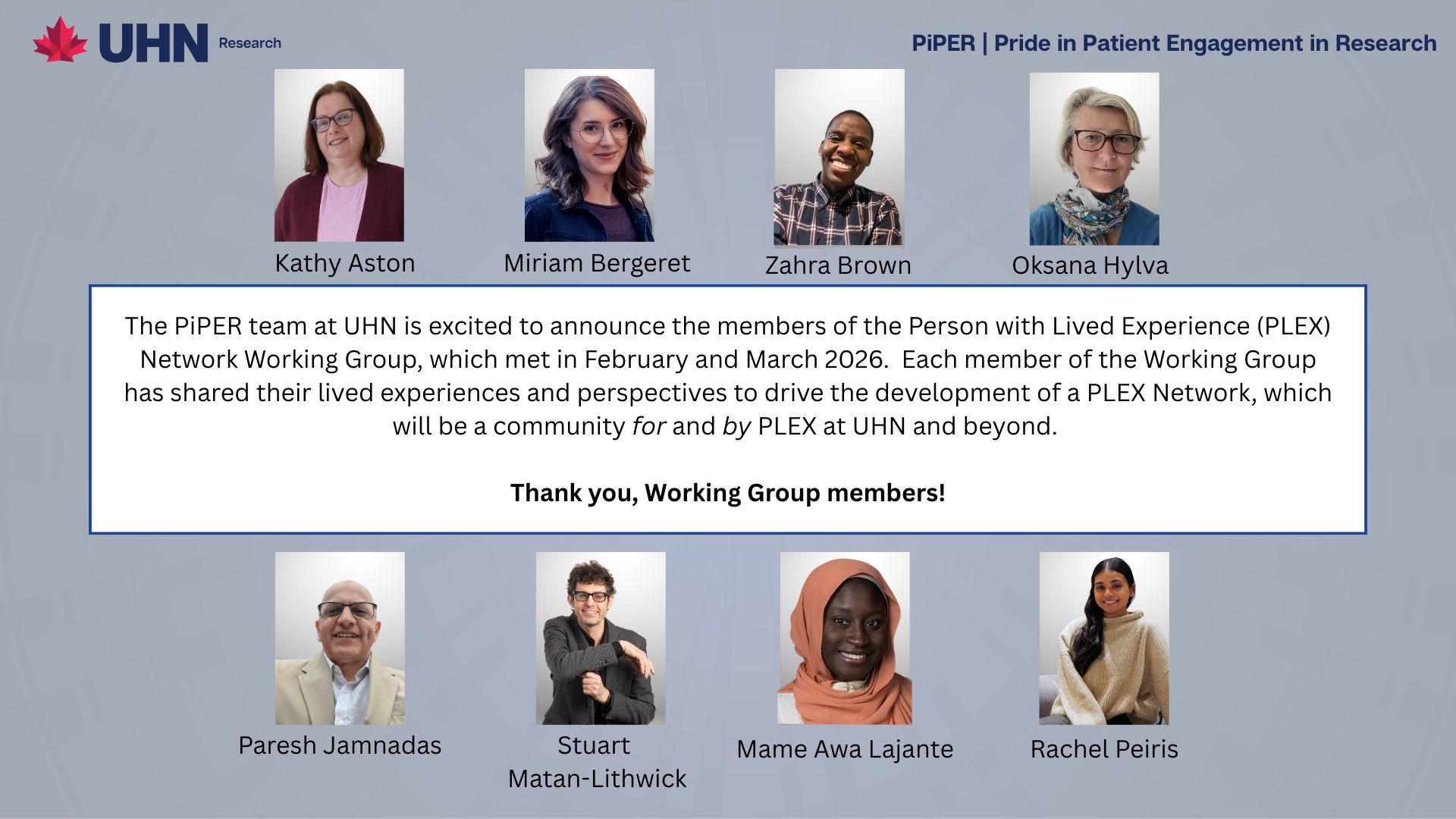
Community consultations and quarterly PLEX Network meetings were held in 2025 to gather input from PLEX and community organizations on the mission and goals of the Network. A working group of eight PLEX members met in February and March 2026 to further define the next steps.
There will be opportunities for PLEX, researchers, research staff, and community organizations to become involved in the Network of Networks.
Become a PiPER member and follow PiPER on LinkedIn and Bluesky to stay up to date.
PiPER Coaching, Matching, and Advisory Services
UHN Research Teams can learn about PiPER Coaching, Matching, and Advisory Services by visiting the PiPER SharePoint (opens in a new window) . External users can contact piper@uhn.ca (opens in a new window) for more information and to request services.
Plain Language Summaries
What is a Plain Language Summary?
A plain language summary (PLS) is a summary of research that is ongoing or completed, that is written in a way that anyone not doing research can understand.
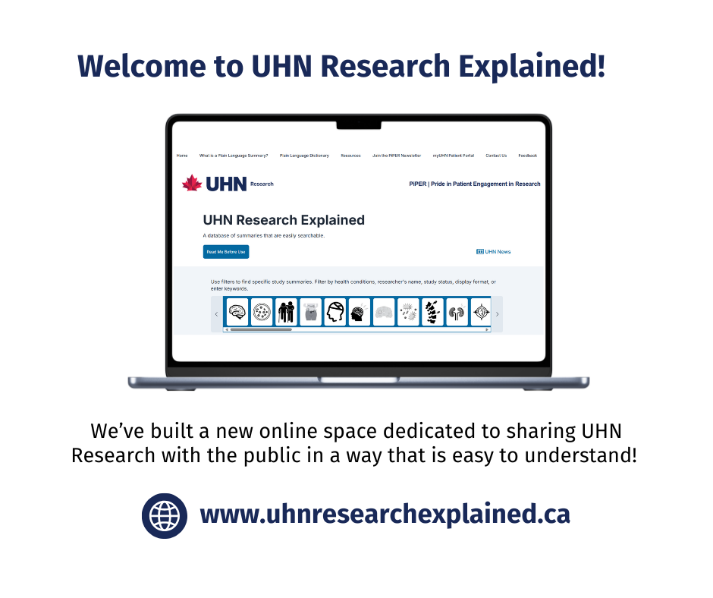
To submit a plain language summary for UHN Research Explained, visit the PiPER SharePoint (Plain Language Resources) [internal connection required] for templates and instructions.