



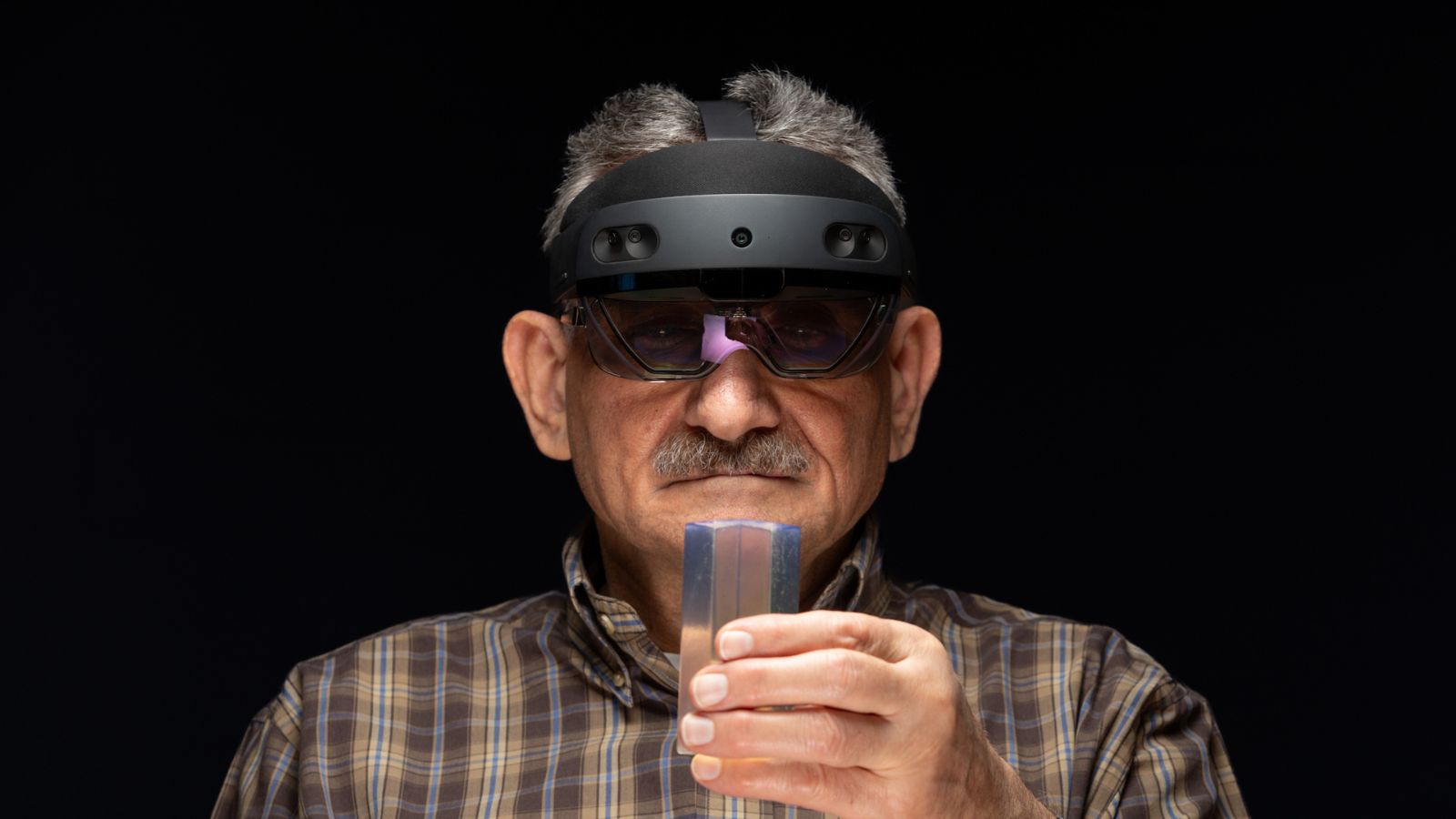
Learnings in VR may be more likely to stick than textbook or classroom lecture instructions.
In hospitals, long-term care homes, and living rooms, virtual reality is being used to calm patients, train caregivers, and help people understand what it means to live with disability.
This is the first in a series of articles about technology and trends changing health care.
There’s a stereotype about virtual reality: that the technology can make people retreat into virtual worlds, isolated from friends and family. But research shows the opposite can be true: virtual reality can help people stay calm in health care settings, engage in the wider world, and better understand each other.
Advancing a more empathetic, accommodating, and inclusive world is one of the goals of the “virtual reality for good” movement, explains Lora Appel, a KITE affiliate scientist who leads UHN's Prescribing Virtual Reality (VRx) Lab. “The advantages of virtual reality, including distraction, immersion, and customization of the experience, can help anybody who is immobile and unable to leave an uncomfortable situation,” she says – including hospital patients and people in long-term care.
But virtual reality's benefits extend beyond health care settings. Virtual reality can also help kids with disabilities play with their friends, and the technology can put people in the shoes (or, in a closer analogy, in the eyes and ears) of people living with a disability or chronic condition.
helping caregivers empathize with people with dementia
Care Equation is an immersive training program designed to help care providers – including nurses, doctors, family caregivers, and personal support workers – better understand what it’s like to live with dementia. (The creator of Care Equation, the North Bay-based Aboot Studios, plans to adapt its platform to other conditions as well, including autism and post-traumatic stress disorder.)
In Care Equation, the person wearing the headset can experience daily life from the perspective of an older person with dementia. The person wakes up in a bed, sees an ominous, cloaked figure across the room (visual hallucinations can occur in dementia), and navigates a bedroom and kitchen with Post-it note reminders and confusing pill holders. Eventually, they try to go to a medical appointment, only to realize that they got the day mixed up.
“We wanted to show ‘a day in the life of,'” explains Jason Rothberg, co-founder of Aboot Studios. “You have to remember to put your glasses on to see and to take your medication. The phone rings, and you don’t know who the person is, but you come to realize it’s your daughter.” The scenarios are based on real-life situations described by people with dementia during focus groups facilitated by The Alzheimer Society.
The impact is twofold – it offers a small but visceral sense of the fear and overwhelm that people with dementia face, and helps users understand why they may be uncooperative, fearful, or even angry. The experience also helps users see how they can help, such as by reintroducing themselves or placing items in easy-to-see locations.
Lessons learned in virtual reality environments like these are more likely to stick than textbook or classroom lecture instructions. “There’s been a lot of work on the sense of awe that you get when you’re in a virtual reality state,” Appel said at an event on virtual reality in health care held at UHN OpenLab. In that state, Appel explained, people are often completely in the moment, and open to new ideas.
Showing promise with mental health and more
Changing perceptions can help patients, too. One ongoing study at Appel’s centre is evaluating whether virtual reality can help patients with epilepsy who are too anxious about having a seizure in public to go out in the world. (For some, anxiety can be more debilitating than epilepsy itself, Appel explains.)
Virtual reality can recreate individual anxiety-provoking situations for people with epilepsy-related anxiety. For example, a VR headset can make a person feel like they’re in a subway by providing the sights and sounds of transit in every direction they look. By encouraging people to confront situations they would otherwise avoid, virtual reality may help them build confidence in a safe, controlled environment before attempting those same situations in real life.
In another study, conducted with older veterans with dementia who were living in a long-term care home, researchers tested whether virtual reality could calm distress without medication and its side effects. Residents were guided through immersive scenes including quiet forests. When researchers used VR at times that would typically trigger agitation, the residents remained calm 46% of the time, suggesting the immersive technology could prevent physical or verbal outbursts among people with dementia.
Many health care workers are interested in incorporating virtual reality into their work. Clinicians have been so impressed with virtual reality's ability to help older people through difficult procedures that interest has grown in making the technology more widely available. “The agencies and the clinicians we've worked with have said, ‘Leave me this product. I want to use it,’” Appel says. To meet that demand, caregiVR, a company Appel and two physicians founded, developed a commercial product.
In one study of ICU health care workers, 69% viewed VR in the ICU positively, while 19% were unsure or mixed, and the rest felt negatively about it. Use cases they identified included entertaining intubated patients with an extended length of stay and alleviating anxiety and pain by intensely engaging patients’ senses.
But the adoption of VR in health care faces challenges. Proving virtual reality’s effect is difficult, since the tool helps with subjective measures of pain, anxiety, or empathy, and many see it as a “nice to have” futuristic device, rather than a medical device, Appel explains. She is pushing health care providers who see VR's potential to develop rigorous, randomized controlled trials that assess physiological responses to complement patient-oriented outcomes. She is also calling on the industry to create lighter headsets that can be incorporated into health care settings.
Making video games more inclusiveBeyond helping people with disabilities, anxiety, or cognitive impairment engage with the world and access health care, virtual reality and thoughtfully designed video games can make play more inclusive for children and adults. For example, MOJII is a narrative-driven video game centred on a cyber-hacker named Kid who has a disability. In the game, Kid completes a series of civilization-saving quests with a parkour-performing robot friend. The game was created by J. Lee Williams and produced by Arthur Yeung, who were part of KITE’s Creators Circle, a venture development program that brought together health care and creative industries. MOJII “incorporates different themes about identity, isolation and accessibility,” Yeung explains, and it was designed with many of the accessibility features highlighted by the Accessible Games Initiative – a standardized system of accessibility labels and best practices created by a group of gaming studios. Alongside the game, the developers prototyped a mixed-reality version called Kid MR that lets players build their own parkour course using simple hand and arm gestures, so it's accessible to people who may not be able to grip a controller or press its buttons. Similarly, Tony Walsh, director at Phantom Compass, is hoping to foster inclusion with his studio’s game, The Vale: Seasons of Promise. The developers designed the game so players with vision loss can rely on audio and spatial cues, while those who are deaf or hard of hearing can follow dialogue and action through subtitles and on-screen indicators. The game builds on the success of its prequel, The Vale: Shadow of the Crown, which was also designed to be accessible. “There were people who reached out and were so appreciative of the opportunity to be able to play games that their sighted friends could also play, and have that shared video game experience,” explains Walsh. | Play with PurposeIn celebration of Toronto Games Week in June 2026, the City of Toronto hosted “Giant Video Games” – an outdoor event that brought together players, creators, enthusiasts, and people who are simply curious about games.This event featured a Play With Purpose zone, co-curated by UHN’s KITE Creates program, to raise awareness of Toronto as a place where games can create real impact. “Just as Toronto hosts globally recognized hospitals, researchers, and health innovators, the region is home to one of North America’s largest concentrations of gaming and creative media talent,” says Garrick Ng, KITE Creates Program Lead, Partnerships & Strategic Initiatives. “We have a unique opportunity to combine these ingredients into a formidable innovation cluster at the intersection of health, science, and creative media.” |
Participating in the KITE Creators Circle helped Walsh and his team better understand the market for accessible video games, and how to reach it. “There is a real business reason to do this that I think was overlooked in previous years,” Walsh says. Yeung adds that being part of the Creators Circle made him realize how Kid MR could also help with rehabilitation and therapy by measuring and encouraging hand and arm movements.
From helping patients confront anxiety to fostering empathy to enabling children with and without disabilities to play side by side, virtual reality and accessible gaming are reshaping who gets to participate and how people relate to each other. Far from being a tool that encourages people to escape the real world, creators and clinicians in this space see it as a tool that helps people thrive and belong.